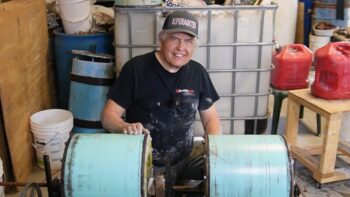
Getting stones ready for polishing starts with the crucial step of grinding them perfectly flat. While running a saw is all about raw power, the flat lap requires patience and a keen eye for detail to ensure your stones are perfectly prepped for the next stage. In our latest workshop session, we put our flat lap to the test [00:24], using a loose 220-grit abrasive to smooth out slices of a diverse variety of materials from around the globe to see what hidden beauty we could reveal.
The Mechanics of the Grind: Mastering the Flat Lap
When you are working with a spinning lap, technique and observation go hand in hand. A crucial first step before you begin grinding is feeling the stone for a small nub left over from the saw cut; this acts as your “leading edge” because it grinds the fastest [00:59]. As you work the stone against the wheel, continuously rotating the piece is essential [01:14]. You must also change its position on the wheel regularly so you do not accidentally grind a groove into your lap plate [01:22].
Listening to the machine is just as important as watching it. You can actually hear a distinct change in sound as the coarse grit breaks down rapidly into a much finer grind [01:57]. Cleaning off the exhausted abrasive and recharging the lap with fresh grit and a squirt of water [02:48] keeps the grinding process moving efficiently.
Another critical lesson is managing the machine’s torque. If you place a stone too close to the outside edge of the wheel, the lap can generate enough torque to rip the rock right out of your hand [14:56]! Keeping the stone closer to the center of the lap reduces this torque significantly [13:14], giving you much better control. Finally, the quality of your initial saw cut drastically impacts your grinding time. A poor hand cut with a deep gouge [10:40] means you have to grind the entire face of the stone down to that depth, whereas a smooth, even cut finishes much faster [15:14].
Hits, Misses, and Masterpieces
Grinding rough rock is a satisfying process that uncovers a stone’s true potential. Here are a few of the most striking pieces from our flat lap session:
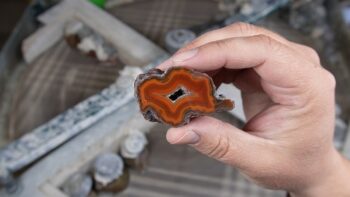
- Laguna Agate: We started with a classic piece, looking to achieve that perfectly flat face. Later, another piece revealed a beautiful bullseye pattern [10:50], though it required extra effort to grind past a deep gouge from an uneven cut.
- South African Tiger Eye: We tackled a piece of this classic material with a large surface area [04:59]. It took a bit more time and an extra round of grit, but the result was a beautifully smooth face that shows off its famous chatoyant flash [07:52].
- Australian Opal: This rough stone was simply gorgeous [08:17]. Because the material is a bit softer than a hard Brazilian agate, we were able to grind away a poor hand cut directly on the lap without needing to take it back to the saw [08:54].
- Nebraska Blue Chalcedony: The state gem of Nebraska is a fascinating material that fluoresces bright green under short wave UV light [12:42]. After fighting a bit of torque on the lap, it ground down nicely to a pristine finish.
- Mexican Agate: We finished with some exciting new material out of Mexico [15:39]. Because it has so many vugs (small cavities), it grinds down very quickly, though it will definitely need a trip through the ultrasonic cleaner to remove all the trapped grit before polishing [16:25].
Whether it is a piece of gorgeous opal showing its true colors [09:38] or a classic Tiger Eye getting prepped for a brilliant finish, every single grind brings us one step closer to a finished gemstone.
If you are looking to start your own slabbing or cabbing projects, be sure to browse our shop for high-quality rough rock and let the lapidary adventure begin!