When you have a truly spectacular, oversized piece of raw agate, you don’t want to chop it down into tiny, manageable chunks. You want to preserve its massive, natural beauty. But how exactly do you tumble a massive slab of agate without breaking it to pieces in the barrel?
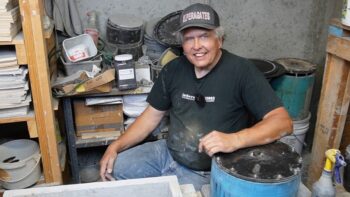
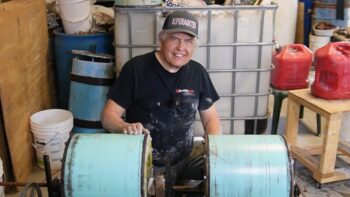
In our latest video, we tackle this exact challenge. We fired up the giant rock tumbler to process four massive slabs of India Moss Agate that were originally acquired and cut out in Quartzsite. It was a heavy, messy, and incredibly rewarding process—here is a behind-the-scenes look at how it went down!
The Setup: Cushioning Giant Slabs
When you dedicate a massive tumbler barrel to a few “target” specimens, the rest of the barrel’s contents are selected specifically to protect those VIP rocks. You can’t just toss four giant slabs into a barrel and turn it on; they would fracture against each other almost instantly.
The Role of Rose Quartz To provide the necessary volume and buffering, we loaded the tumbler up with a massive amount of Rose Quartz [03:36]. Rose Quartz is the ultimate “go-to” filler for tumbling large specimens. It shares the same hardness rating as agate, but it acts much less harshly on the target stones during the tumble. As an added bonus, at the end of the process, those rough chunks turn into gorgeous, polished pink gems [03:50].
Adding Variety to the Barrel To round out the load, we threw in a colorful “potluck” of materials, including Sodalite, Zambian Amethyst, Malawai Agates, and about five pounds of deep red African Jasper [01:24]. A diverse barrel isn’t just fun to open later—it ensures the tumbler operates efficiently with a good mix of sizes rolling together.
The Strategy: Extending the Rough Grind
Typically, a rough grind (using 60/90 grit) lasts about a week to ten days before moving on to finer grits. However, for this batch, the stones were left in the rough grind stage for a remarkably long time.
The Benefit of a Long Grind When you leave stones rolling in a coarse grit for an extended period, the grit eventually breaks itself down. What starts as a harsh 60/90 abrasive slowly pulverizes down to a fine 2,000+ grit slurry [08:24]. This means that by the time you open the barrel, the stones aren’t just shaped—they are incredibly smooth. In fact, they are so smooth that they can bypass the intermediate stages and jump straight into the final polish tumbler [09:50].
The Downside: The “Slime” Factor The trade-off for this shortcut is the mess. Because the grit breaks down into such a fine, microscopic powder, the inside of the barrel turns into a sticky, slimy mud [08:17]. When it’s time to empty the barrel, a standard hose isn’t going to cut it. It takes a power washer and a round in the ultrasonic cleaner to get all that broken-down slurry out of the rocks’ natural vugs and crevices.
The Grand Reveal: Giant India Moss Agate
The cleanup effort was completely worth it. The four massive slabs of India Moss Agate emerged from the sludge intact, incredibly smooth, and ready for their final polish [13:19].
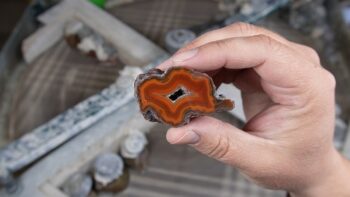
The size of these pieces is truly staggering. Holding one of these slabs up to the light reveals a chaotic, beautiful mix of translucent quartz and sprawling green mossy inclusions [14:07]. They possess a raw, earthy character—complete with deep natural vugs—that makes them feel like a miniature landscape frozen in stone.
While they still need a couple of weeks tumbling with ceramic media to achieve that brilliant, glass-like reflection, the raw potential revealed in this rough grind is absolutely spectacular!
Want to try your hand at tumbling large specimens or colorful filler stones? Browse our shop for rough rock, reliable tumbling grit, and everything else you need for your lapidary projects.
 USLAB145
 USLAB147
 Fairburn
 USLAB118
 YT127
 Fairburn
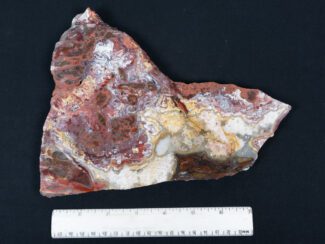 Unpolished Crazy Lace Agate Slab
 USLAB156
 Red Jasper Tumbling Rough (Per LB)