One of the most rewarding aspects of lapidary work is the element of surprise. You put rough, carefully selected stones into a tumbler, listen to them grind for weeks, and eventually get to open up the barrel to see what nature has been cooking.
In the video below, we tackle the exciting—and admittedly messy—process of opening up a giant rock tumbler that’s been running for quite some time. We’ll show you exactly what happens when agates are left in the rough grind stage for several weeks and explain some unconventional tumbling methods that yielded spectacular results!
Key Takeaways from the Giant Tumbler Opening
Tumbling stones on a large scale requires a bit more nuance than a standard countertop tumbler. Let’s break down some of the most interesting concepts covered in this video.
The Sludge Factor: Why the Tumbler Gets Gummy When you first open a tumbler that has been running for three to four weeks, you’ll immediately notice the thick, sludgy mess inside [01:25]. In this specific run, the grit had completely broken down. The gummy texture happens when softer minerals, like the calcite found on the backside of Crazy Lace Agate, break down during the tumbling process and mix with the water and grit [02:46]. While it takes a fair amount of cleaning—often with the help of an ultrasonic cleaner—the initial sludge is totally normal.
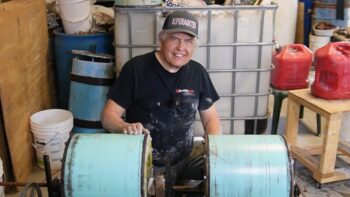
The Importance of Tumbler Size and Cushioning To tumble large, showpiece agates properly, you need the right amount of space and cushioning. If you were using a standard 12-pound tumbler, you could typically only fit a single large piece of Crazy Lace Agate at a time so that it has room to migrate around [10:00]. Using a giant tumbler (which weighs 83 pounds empty!) allows for a higher volume of large stones to tumble together safely, as long as you add smaller filler stones to cushion the load.
Breaking the Rules: Mixing Hardness Levels If you look at most rock tumbling tutorials, they will tell you one cardinal rule: always tumble stones of the same hardness. However, this video breaks that rule entirely [06:28].
In the rough grind stage, a mix of Red Jasper, Rose Quartz, and Fluorite were all tumbled together. Fluorite is considerably softer than the others, but as long as you are doing a rough grind and are willing to accept the natural wear on the softer stones, it can actually work beautifully [06:54].
The Beauty of Contrast and Eyes
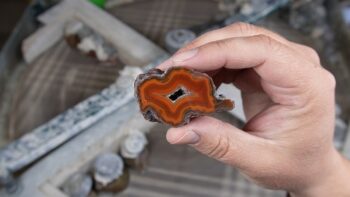
The undisputed stars of this tumbler batch were the Crazy Lace Agates. When hunting for high-quality tumbling stones, the key element you want to look for is contrast [05:31]. A stone that is solid in color is rarely as stunning as one with stark, varied layers.
In this batch, the high contrast beautifully highlights the stone’s “eyes”—the concentric, circular banding patterns that are so prized among lapidary enthusiasts [05:51].
The Payoff: A Beautiful Pre-Polish Sheen
Interestingly, leaving the tumbler running longer than usual can actually have some benefits. After sitting in the rough stage for weeks, the stones emerged with a remarkable smoothness and a slight pre-polish sheen directly out of the barrel [11:07]. From this stage, they are ready to bypass intermediate steps and head straight to a 1500 grit or even directly to the final polish [03:53].
Ready to start your own tumbling project? Browse our shop for rough tumbling stones and high-quality grit to start revealing the hidden beauty of the earth!