Whether you are a seasoned lapidary enthusiast or simply appreciate the natural beauty of gemstones, understanding the stone polishing process gives you a much deeper appreciation for the finished pieces you collect. Polishing transforms a rough, unassuming rock into a smooth, brilliantly reflective specimen, revealing intricate patterns and colors hidden within.
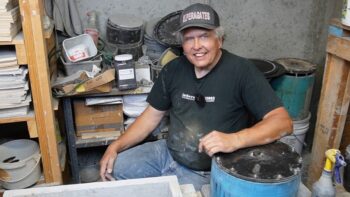
To give you a behind-the-scenes look at how this transformation happens, we’ve shared an incredibly insightful video below that walks through the step-by-step process of polishing various agates and jaspers.
Key Takeaways from the Polishing Process
If you’re curious about the mechanics of lapidary work, the video highlights several important techniques and concepts required to achieve a glass-like finish on hard stones.
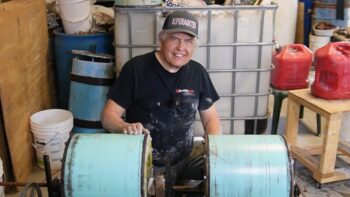
The Right Setup and Materials Achieving a quality polish requires precision and the right materials. The process starts by adding a bit of distilled water to the polishing machine [00:31]. Instead of standard grit, a high-grade cerium oxide is applied as the polishing agent [00:45]. It’s a delicate balance—using too much or too little can impact the final result.
Protecting the Stones Because the stones need downward pressure to polish correctly, weights are added to the top of each stone. Interestingly, a small piece of tissue (like Kleenex) is placed between the stone and the machine’s holding mechanism [02:54]. This simple step ensures that the equipment doesn’t accidentally scratch the back or sides of the rock while the face is being polished.
Preventing Grooves During the process, the machine gently moves the stones back and forth [04:30]. This slight, continuous shifting is crucial; it prevents the cerium oxide from staying in one exact spot and developing a groove in the pad or the stone itself.
Patience and Timing Depending on the batch, the stones generally run on the polisher for about 40 minutes to an hour [05:02]. However, not all stones are created equal. The time it takes to reach a perfect shine can vary significantly depending on the stone’s hardness and mineral makeup. For instance, stones like Laguna agate tend to polish very quickly, whereas varieties like Blue Lace agate are much slower to finish [11:08].
The True Meaning of a “Polished” Stone
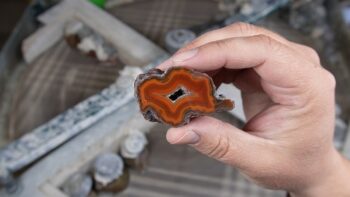
One of the most fascinating concepts mentioned in the video is the realization of what a “polish” actually is in the lapidary world [07:56]. Before learning about rocks, many people assume that polishing a stone is like applying shoe polish or clear nail polish—putting a shiny, artificial coating over the surface.
In reality, polishing a rock means smoothing the physical surface to such an extreme, microscopic degree that the stone itself naturally reflects light. There are no clear coats or glossy sprays; the shine you see is the pure, raw material.
A Showcase of Natural Beauty
The batch featured in the video includes a beautiful variety of materials from around the world, all of which take a polish beautifully:
- Tiger Eye: Known for its striking blue, green, and gold chatoyancy [05:51].
- Moroccan Agate: Showcasing bold, warm colors [07:01].
- Dendritic Opal (Australia): Featuring beautiful, tree-like inclusions [05:25].
- Nebraska Chalcedony & Crazy Lace Agate: Distinctive patterns that pop beautifully once smoothed [08:42].
Every stone reacts differently, and sometimes a rock that looks unpromising during the early stages turns out to be the most spectacular piece in the batch once the final polish is achieved.
Have a favorite type of agate or jasper? Browse our current collection of polished stones to see these beautiful natural patterns up close!
 USLAB145
 USLAB147
 Fairburn
 USLAB118
 YT127
 Fairburn
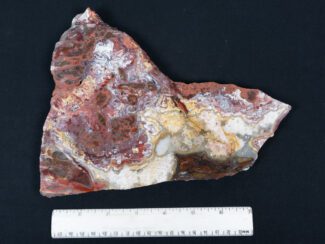 Unpolished Crazy Lace Agate Slab
 USLAB156